What does vermin control cover?
In professional use, vermin control is an umbrella term: it covers treatments that don’t fall under standard insect or rodent control. These are typically pests tied to a specific structure, material or source.
In everyday speech the term often means something else: many people call rat and mouse control “vermin control”. If that’s what you’re looking for, you’re in the right place — we also provide rodent control, at facilities, institutions, on municipal public land, in sewer networks and at family homes, with decades of practice.
Wood-boring insects
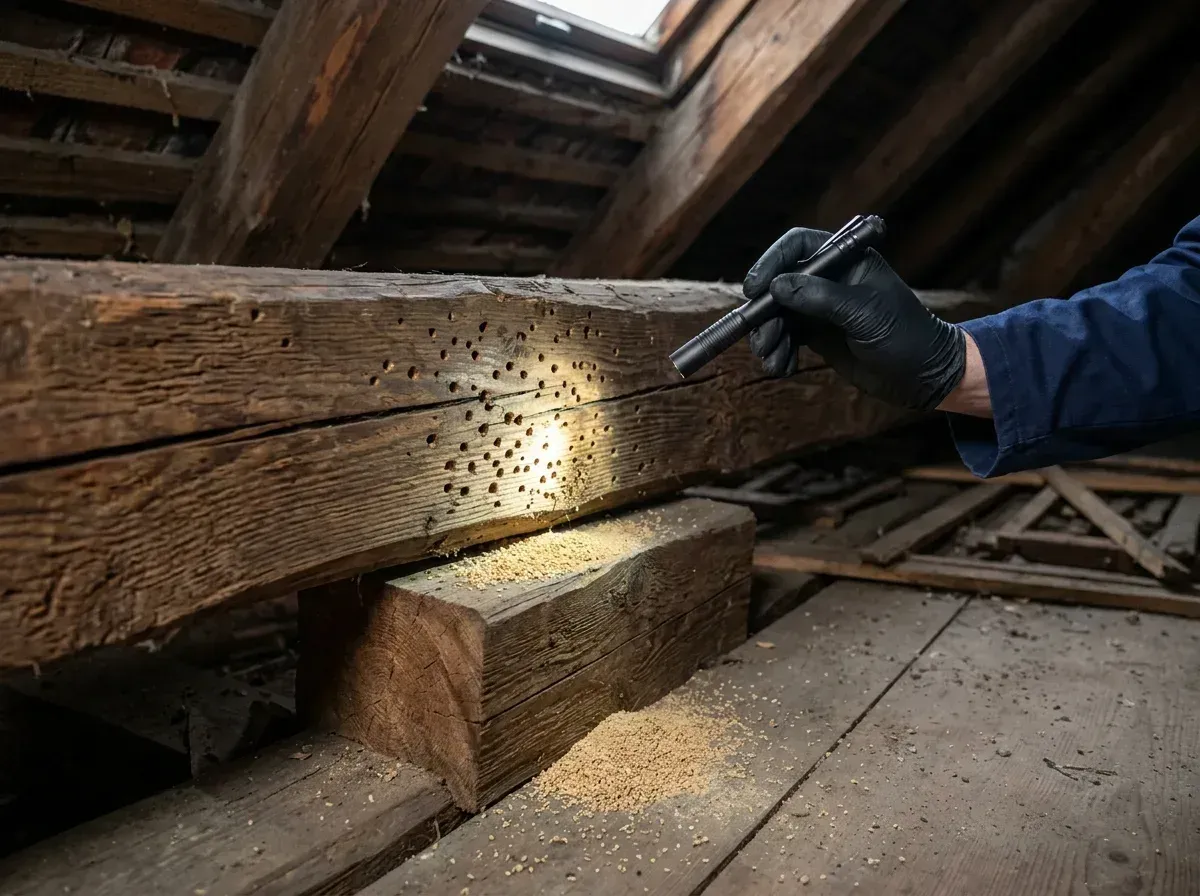
These are insects that settle in timber structures — roof structures, beams, wood panelling — chiefly the woodworm and longhorn beetle families, including the house longhorn beetle. The damage often only becomes visible once the structure’s load-bearing capacity has already dropped, so early detection matters. The method depends on the structure’s material, size and accessibility.
Mites and bird-associated pests
Pigeon mite and bird lice move from an abandoned bird’s nest into the interior of a building. In these cases, treatment only lasts if the source is eliminated too: the nest has to be removed, and nesting has to be physically prevented (grilles, spikes).
Moisture-associated pests
The appearance of silverfish, woodlice and centipedes usually signals a moisture problem. Here too, the lasting solution is structural: without eliminating the source of moisture, treatment is only temporary.
Procedure
We always start with species identification, because it determines the method. This is followed by identifying the source, the treatment itself, and — where needed for a lasting result — structural recommendations for prevention.