Rodent control is sometimes called “vermin control” in everyday speech. If that’s the term that brought you here, you’re in the right place — this page covers rats and mice. We cover vermin control in its technical sense — woodworm, mites and other arthropods — on its own dedicated page.
Why monitoring, not occasional treatment?
Occasional rodent treatment addresses the symptom. In a production environment, rodent pressure is constant — reinforcements arrive continuously from surrounding land, the sewer network and incoming deliveries. That is why both the trade and the standards expect a permanent, documented monitoring network that flags an infestation before it develops.
How the system is built
Designating monitoring points
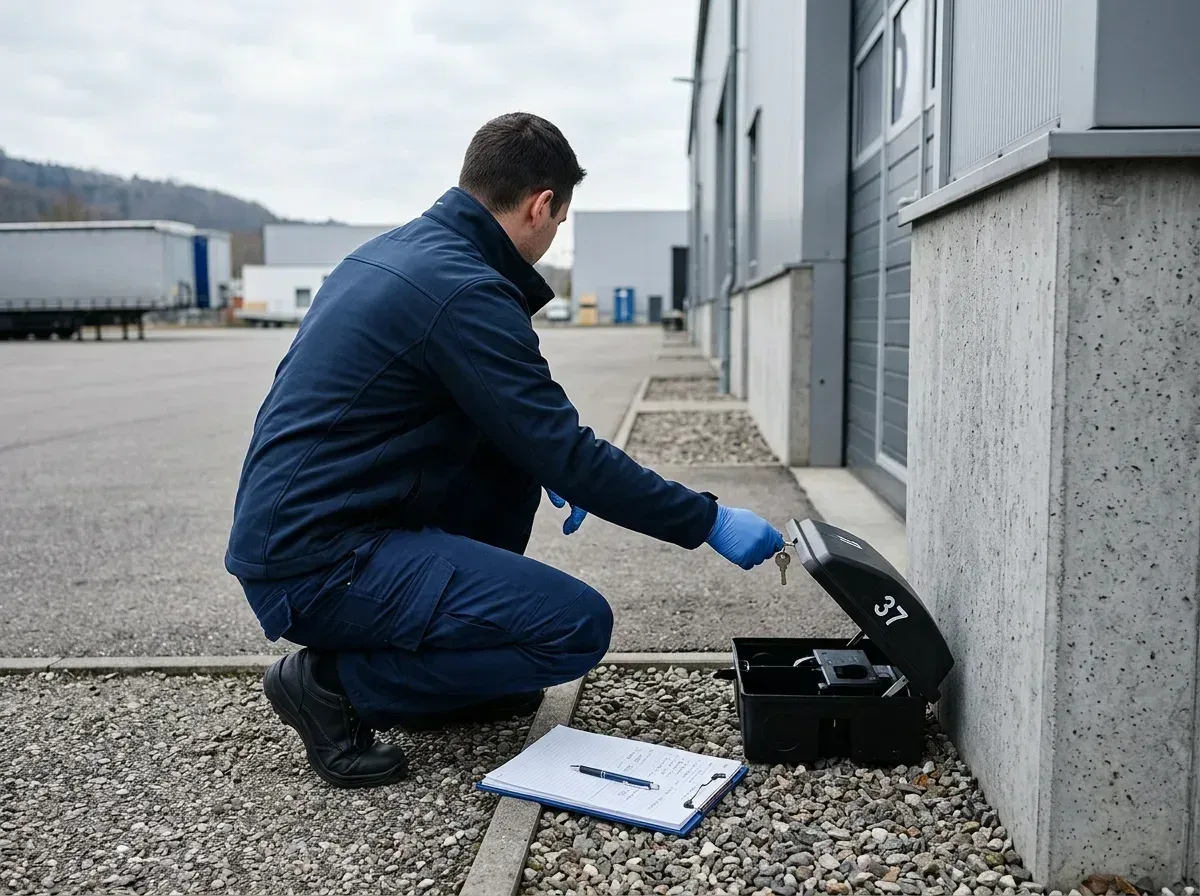
Points are set along the routes of entry: the fence line, the building’s outer wall, loading doors, drain shafts, waste storage, raw-material intake. Every point is numbered and added to the site plan.
Equipment
Outdoors we use lockable, fixed bait stations; indoors — where bait use is restricted for food-safety reasons — we use mechanical traps and glue-board monitors. The choice of equipment always depends on the food-safety classification of the zone.
Scheduled inspection
Inspection frequency is set by risk: typically monthly in a food-processing plant, more frequent in a high-risk area. Every inspection concludes with a report.
Trend analysis
The real value is in the data series. If consumption at a point rises month over month, it signals that pressure has increased in that section of the property — and fixing the structural gap there is worth more than replenishing the bait.
Different approaches for mice and rats
The house mouse has a small home range, often spending its entire life cycle inside the building, so it needs a denser indoor point network. The brown rat, by contrast, covers a wider area, typically arrives from outside, and perimeter protection is the effective tool against it. Defence against the two species is therefore not interchangeable.
Mouse control
The house mouse is small-bodied, gets in through the smallest gaps, and breeds extremely quickly: under favourable conditions, a single female can raise several dozen offspring a year. Because its home range is small — typically a few metres from the nest — the indoor point network has to be dense, or the animal simply never encounters a device.
In food-industry zones, bait use is typically restricted, so here too we use mechanical traps and glue-board monitors. A lasting result also requires physically sealing entry points: a mouse can fit through a 6–7 mm gap, so sealing cable ducts, pipe penetrations and door thresholds is part of the defence.
Rat control
The brown rat is larger-bodied, more cautious, and typically arrives from outside: from the sewer network, surrounding land or waste storage areas. It is initially wary of new objects, so it can take days after bait stations are installed before it accepts them.
Perimeter protection is the effective tool against it: a network of lockable bait stations along the property’s outer line, near gates, drain shafts and waste storage areas. Indoor intervention alone is not lasting while the outside pressure persists.
Municipal public land and sewer networks
We carry out rodent control on municipal public land, in sewer networks and in flood-affected areas, with a guarantee and references. Rat control on public land is a different scale of task from a single site: the source is the sewer network, waste management and the waterfront, so the treatment has to be carried out across a connected area all at once — the population recolonises an untreated section within a few weeks. After a flood the task is more urgent: rising water displaces rats from the sewer system and from burrows along the bank, pushing the animals into inhabited areas.
Our ten independent crews work across several localities at once, and we run the programme on a documented, area-by-area schedule — backed by decades of professional experience, at a fair price. Not the cheapest one, though: our quote includes the full dose and the follow-up check. A conspicuously low fee often doesn’t even cover the cost of the product used, and rodents typically return within a few weeks after such a treatment. We prepare every quote individually, based on the site and the task at hand. How is a programme like this structured, and what does public procurement require? We cover that on our page for municipalities.
Documentation
A site plan with numbered points, inspection reports, a summary of catch data, safety data sheets and copies of authorisations — together, in audit-ready form.
What exactly does an audit expect from pest control documentation? We cover that in our guide to HACCP pest control requirements.